Published by

You are about to invest six to twelve months and thousands of pounds into an AI implementation. Yet 61% of AI consulting engagements result in unplanned vendor lock-in within eighteen months, and 80% of AI projects fail entirely. The difference between success and a costly mistake often comes down to one thing: how carefully you choose your consultant.
This guide provides a practical twelve-point evaluation checklist to help you select the right AI consultant—one who will build capability within your organisation rather than create dependency, who prioritises knowledge transfer over tool deployment, and who owns their outcomes rather than simply delivering hours.
Definition: An AI consultant is a strategic partner who evaluates your business challenges, recommends AI-driven solutions, manages vendor selection, oversees implementation, and transfers knowledge to your team. Critically, the best consultants build your internal capability so you are never dependent on them.
Key Takeaway
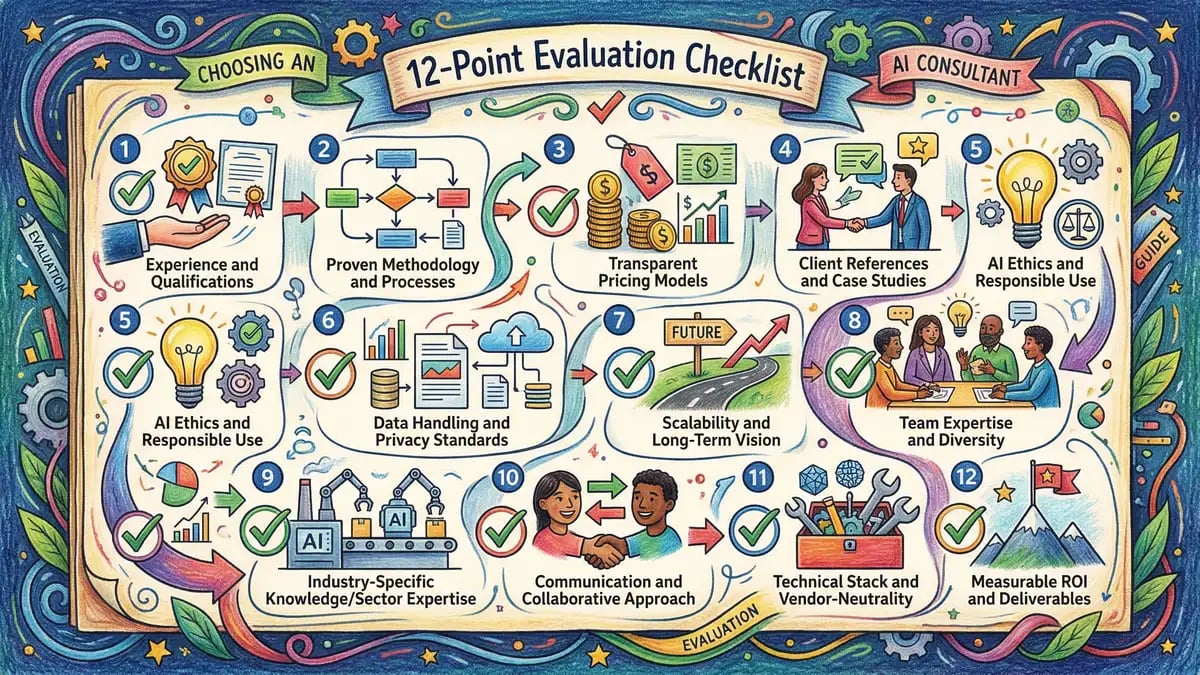
Use this twelve-point checklist to evaluate consultants objectively. One unchecked box does not disqualify a candidate, but patterns of missing criteria are warning signs. The checklist works across budget sizes—from £30k boutique engagements to £300k+ enterprise builds.
Why Choosing the Right AI Consultant Matters
An AI consulting engagement is not a transaction; it is a twelve-month partnership during which you will make business-critical decisions, allocate significant resources, and reshape your team's capabilities. The stakes are high:
- 80% of AI projects fail to deliver their intended business value. Failures cluster around poor vendor selection, inadequate change management, and insufficient internal capability-building.
- 61% of AI engagements result in vendor lock-in, trapping organisations into ongoing tool licensing, bespoke integrations, and consulting dependency.
- Investment scale is material: Custom AI builds range from £60k to £300k+, with implementations lasting six to twelve months. Budget £100k–£500k for a typical mid-market transformation.
- 28% of AI consulting disputes involve unclear IP ownership, often resulting in eighteen to twenty-four months of legal AI for legal teams conflict costing £50k–£200k to resolve.
Cost of Getting It Wrong
Scenario 1—Vendor Lock-In: Six-month engagement costs £80k. Within twelve months, switching costs amount to £150k–£500k. Total cost of the "mistake": £230k–£580k.
Scenario 2—Project Failure: Twelve-month engagement costs £180k. Project delivers zero measurable ROI and your team is left without internal capability. Recovery requires a second engagement (£100k–£150k) or prolonged internal rebuilding (three to six months lost time).
Scenario 3—IP Dispute: Unclear ownership language in contracts leads to eighteen-month legal process. Legal fees: £50k–£200k. Business disruption and reputational damage: incalculable.
The solution is not to avoid AI consulting. Organisations that work with the right consultant—one aligned to their capability-building goals and accountable for outcomes—see measurable results in six to eight weeks and build internal capability that compounds over years.
The Twelve-Point AI Consultant Evaluation Checklist
Use this checklist to evaluate every consultant you interview. Score each criterion as "Met" (✓), "Partially Met" (~), or "Not Met" (✗). Patterns matter more than individual items, but certain criteria—particularly #5, #8, and #12—are non-negotiable for engagements above £100k.
-
Documented Methodology
Ask for case studies showing a repeatable, structured process. Are they documenting their methodology? Can they walk you through how they approach evidence-based transformation methodologyed a similar problem? 80% of AI project failures stem from lack of systematic approach; consultants with clear, documented methodologies significantly outperform those improvising project-by-project.
-
Relevant Industry Experience
Seek two to three case studies specifically in your sector. If they are a financial services AI consultant, they should have demonstrable experience with compliance, audit trails, and risk management specific to banking or insurance. If they work in retail, they should understand inventory management, customer segmentation, and supply chain dynamics. Industry knowledge accelerates time-to-value.
-
Technology-Agnostic Approach
Review their project portfolio. Do they use multiple AI platforms and tools, or are they locked to one vendor (e.g., "we only recommend OpenAI" or "we are a certified Google Cloud partner")? Vendor exclusivity is the primary driver of lock-in (61% of engagements). Genuinely technology-agnostic consultants evaluate tools objectively and recommend based on your use case, not their partnerships.
-
Knowledge Transfer Commitment
Ask explicitly: "How will you hand this over to my team?" 95% of AI pilots fail because organisations lack internal capability. The best consultants invest heavily in documentation, training, and team upskilling. They see their job as complete only when your team can own and evolve the solution without them. This is the primary differentiator between implementations that succeed long-term and those that create permanent dependency.
-
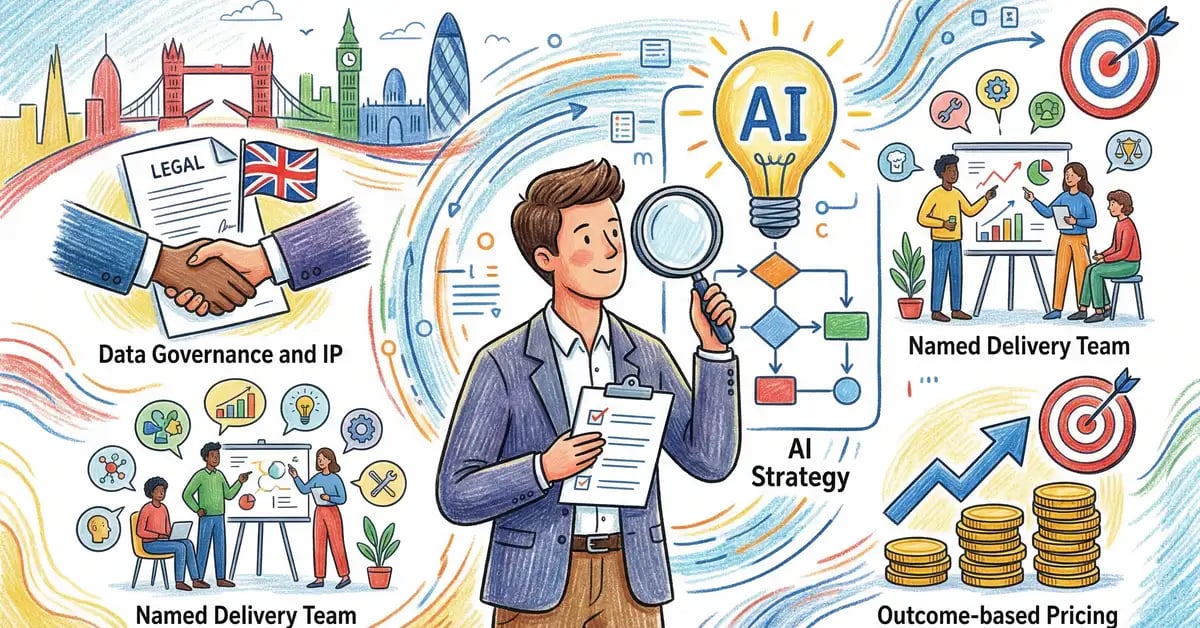
Data Governance Rigour
Non-negotiable. 34% of AI engagements flagged data protection risks during post-implementation audit. Ask how they ensure GDPR compliance, handle data anonymisation, maintain audit trails, and manage vendor data usage. This must be discussed and documented before the engagement, not discovered through painful audits six months in.
-
Named Delivery Team
Request specific names, titles, and time commitment for your project. Will the same people you interview be delivering the work? "Bait-and-switch"—selling you a senior partner, then assigning junior consultants—is a common failure pattern. Continuity of delivery team is strongly correlated with project success.
-
Outcome-Based Pricing Options
Ask whether they will consider outcome-based pricing (payment tied to measurable results) rather than fixed-scope, time-and-materials, or daily-rate models. Outcome-based contracts align incentives and have 40% higher success rates than fixed-scope arrangements. Even if your engagement is fixed-scope, asking about outcome models reveals whether the consultant has "skin in the game."
-
IP Ownership Clarity
Non-negotiable. Have your lawyer review the IP clause before signing. Critical questions: Who owns the models? Who owns the methodology? Can you use it after the engagement ends? 28% of AI consulting disputes centre on ambiguous IP language. Get this explicitly clear in writing.
-
Reference Availability
Request three to five willing references, prioritising clients who can speak honestly about challenges faced, not just successes. Ask references: "What would you do differently next time?" and "What did this consultant struggle with?" Honest references reveal true engagement quality. Cherry-picked references are a warning sign.
-
Professional Indemnity Insurance
For engagements above £500k, require minimum PI insurance of £5–10m. Request a certificate of insurance. This is a financial safeguard and a proxy for the consultant's risk management maturity and operational stability.
-
ISO/IEC 42001 Certification (or Equivalent)
ISO/IEC 42001:2023 is increasingly required for government contracts and regulated sectors. If your sector requires it, prioritise consultants with certification or a documented equivalent AI governance framework. Only 15% of UK consultants hold this certification, and adoption is growing 40% year-over-year.
-
Post-Project Support Plan
Ask about their approach after go-live. How long will they remain available for questions? What does ongoing support look like? A consultant who disappears after delivery creates risk; a consultant with a structured handoff and support SLA is committed to long-term outcomes.
Red Flags: What to Watch For
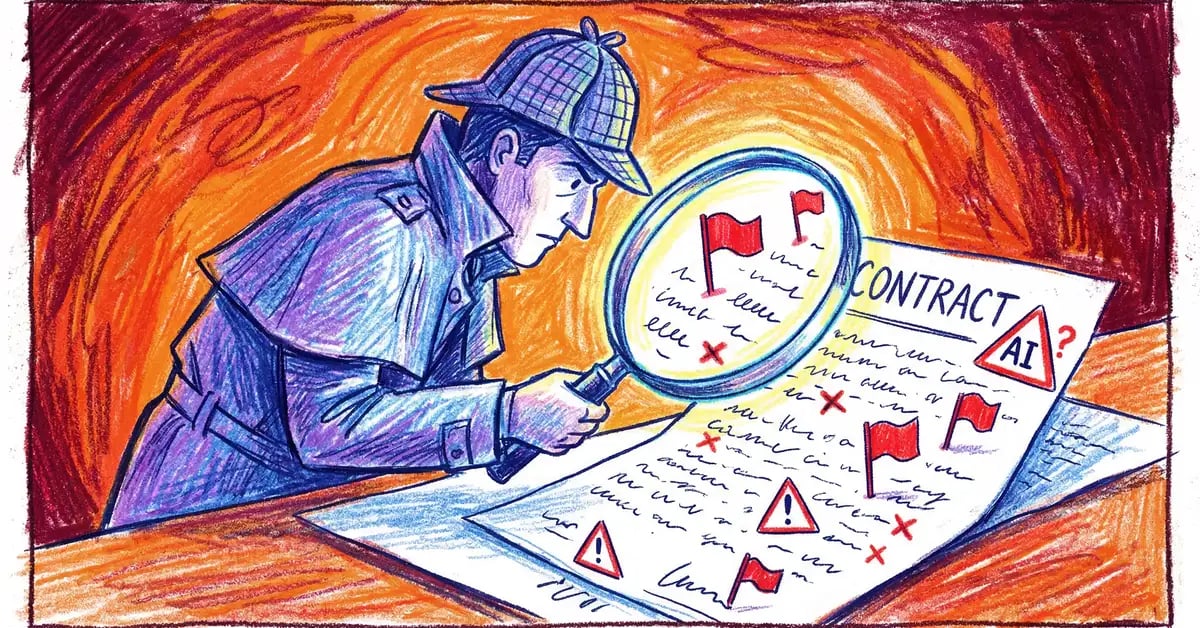
Certain statements and omissions should raise immediate concerns. Use this table to flag risks in real time during conversations.
| Red Flag | What It Signals | Risk Level |
|---|---|---|
| "Guaranteed ROI" or "100% success" | Unrealistic promises; lack of accountability | CRITICAL |
| Vendor exclusivity ("we only use Platform X") | Likely to drive vendor lock-in | CRITICAL |
| Unclear IP ownership ("we retain rights to methodology") | Likely disputes later; blocks your independence | CRITICAL |
| Data governance not mentioned upfront | High post-implementation audit risk (34% issue rate) | HIGH |
| Pressure to sign quickly; dismissal of risk questions | Sales AI for sales teams-driven, not consultant-driven mindset | HIGH |
| No documented failure scenarios or risk mitigation | Immature risk management practices | HIGH |
| Vague references; reluctance to provide them | Hidden engagement quality issues | MEDIUM |
| No post-project support plan ("deliver and leave") | Engagement risk; orphaned projects; dependency | MEDIUM |

Big 4 vs. Boutique vs. Specialist: Which Type Is Right for You?
The UK AI consulting market is segmented into three distinct tiers, each with different strengths, weaknesses, and appropriate use cases.
| Dimension | Big 4 (Deloitte, PwC, Accenture, EY) | Boutique (Faculty AI, Data Reply, Future Processing) | Specialist/Freelance |
|---|---|---|---|
| Speed to Delivery | Slow (8–12 months) | Fast (6–8 weeks) | Fastest (2–4 weeks) |
| Budget Range | £100k–£500k+ | £30k–£150k | £5k–£30k |
| Governance & Compliance | Excellent (Big 4 = gold standard) | Good–Excellent | Variable; often weak |
| Knowledge Transfer | Strong (documented processes) | Strong (direct team access) | Variable |
| Vendor Lock-In Risk | Moderate (large teams) | Low–Moderate | Low |
| Outcome-Based Pricing | Rare (fixed-scope standard) | Common (40%+ of boutiques) | Negotiable |
| Best For | Enterprise, regulated sectors, >£500k, needs credibility | Mid-market, pilots, SMEs, budget-conscious | Scoped tasks, experienced teams |
| Risk Profile | Lower execution risk; higher cost | Balanced | Highest execution risk; lowest cost |
Decision Framework
Choose Big 4 if: Budget >£500k, regulated sector (finance finance sector AI implementation, legal, healthcare), compliance non-negotiable, credibility to board critical.
Choose Boutique if: Budget £30k–£150k, 6–8 week pilot timeframe, mid-market company, want direct access to senior consultants, prefer outcome-based pricing.
Choose Specialist if: Budget <£30k, highly scoped problem, your team has AI experience, timeline under four weeks, low execution risk tolerance.
Critical Questions to Ask Before Signing
Use these eight questions during your final consultant interviews. Detailed, honest answers are good signs. Evasion or oversimplification are warning signs.
-
"Can you show me two to three case studies in our industry, including what you would do differently next time?"
Why it matters: Industry relevance is critical. Willingness to discuss improvement areas signals honesty and learning culture.
-
"Who specifically will be on our delivery team, and what happens if they leave mid-project?"
Why it matters: Continuity is essential. Bait-and-switch (selling you a partner, delivering a junior) is a common failure pattern.
-
"Walk me through your data governance process. How do you ensure GDPR compliance?"
Why it matters: 34% of AI engagements flag data protection risks post-implementation. This must be clear upfront.
-
"After six months, what does our team's capability look like? Are we dependent on you for ongoing support?"
Why it matters: Tests the consultant's commitment to knowledge transfer and independence-building. Avoids vendor lock-in (61% problem).
-
"Show me the IP ownership clause. Who owns the models, the methodology, and the data after the engagement ends?"
Why it matters: 28% of disputes centre on IP ambiguity. Have your lawyer review. This must be crystal-clear in writing.
-
"Would you be open to outcome-based pricing rather than fixed-scope?"
Why it matters: Outcome-based contracts have 40% higher success rates. Willingness to discuss signals confidence and alignment.
-
"What is your PI insurance coverage, and how do you handle disputes?"
Why it matters: Financial safeguard for >£500k engagements. PI insurance is proxy for financial stability.
-
"Can I speak with three clients who can share honest feedback—including challenges they faced?"
Why it matters: Honest references reveal true quality. Cherry-picked, glowing references are a red flag. Ask references directly: "What went wrong? What would you do differently?"
Use Our Evaluation Checklist
Save the twelve-point checklist above and print it out. Use it to score each consultant interview in real time. Patterns reveal fit faster than gut feel.
Contact us with questionsFrequently Asked Questions
Q: How much does an AI consultant cost in the UK?
A: Typical UK pricing ranges from £80–200 per hour for freelance contractors, to £1,000–1,800 per day for boutique agencies (a six to eight week engagement = £30k–£72k), to £15k–50k for strategy projects and £60k–£300k+ for custom AI builds over six to twelve months. Outcome-based pricing, available from 41% of consultants, can reduce costs and improve accountability.
Q: How long does an AI consulting engagement take?
A: Typical timeline: discovery and scoping (one to two weeks), education and planning (two to four weeks), implementation (four to eight weeks), knowledge transfer and handoff (two to four weeks). Total: six to twelve months for custom builds. Quick-win pilots typically run six to eight weeks. RFP evaluation itself takes twelve to sixteen weeks traditionally, or six to eight weeks with structured frameworks.
Q: What is the difference between an AI consultant and a data scientist?
A: An AI consultant focuses on strategy, vendor selection, implementation roadmap AI implementation roadmaps, change management, and capability-building. They are often not building code themselves. A data scientist focuses on model development, statistical analysis, and technical implementation. Many successful engagements need both roles. Verify that your consultant brings strategic thinking and hands-on technical leadership, not just one or the other.
Q: Do I need an AI consultant if I have an IT team?
A: It depends on your team's AI expertise. If your team has AI experience, a consultant can focus on strategy and vendor selection. If not, yes—you need a consultant. IT teams excel at infrastructure; they often lack AI-specific methodology, change management, and vendor evaluation skills. 61% of engagements result in vendor lock-in; having external expertise to evaluate options reduces this risk significantly.
Q: How do I measure AI consulting ROI?
A: Common metrics: efficiency gains (40% average improvement in process time is an industry benchmark), cost savings (£X reduction in manual work), revenue impact (£X new revenue or pipeline improvement), and time-to-value (speed to first measurable result; six to eight weeks is industry standard). Outcome-based pricing models make ROI measurement mandatory—which is why they have 40% higher success rates than fixed-scope contracts.
Ready to Evaluate AI Consultants?
Use the twelve-point evaluation framework above to compare consultants objectively. Helium42 is built on the principles that matter most: education-led implementation, knowledge transfer over dependency, and measurable outcomes.
Our unique approach: We prioritise building your internal capability so you never depend on us. Our typical engagements deliver 40% efficiency gains in six to eight weeks, with outcomes-based pricing and full IP ownership for you.
Conclusion
Choosing an AI consultant is one of the most consequential decisions you will make in your digital transformation journey. The stakes are high: 61% risk of vendor lock-in, 80% project failure rate, and investments of six figures and six to twelve months of your team's time.
But the good news is that the risk is measurable and manageable. Use the twelve-point evaluation checklist to assess consultants objectively. Look for documented methodology, relevant industry experience, knowledge transfer commitment, data governance rigour, and outcome-based pricing alignment. Avoid consultants making unrealistic promises, locking you into exclusive vendor relationships, or ignoring data governance and IP clarity.
The best consultant is not the biggest or the most expensive. It is the one whose incentives are aligned with yours—who builds your capability rather than creating dependency, who owns measurable outcomes, and who sees the engagement as successful only when your team can evolve the solution without them.
Read our full AI consultancy guide for a deeper dive into consultancy services, follow our step-by-step AI implementation roadmap for a week-by-week deployment plan, or explore our guide to AI training for business teams to build the internal capability that makes every implementation succeed.
Sources and Data Points
This article synthesises research from ten authoritative sources including TechUK, Forrester, Gartner, Boston Consulting Group, Law Society, UK Information Commissioner's Office, ISO, MIT Sloan, RAND Corporation, and industry procurement standards. Data includes 18 specific statistics covering market structure, vendor lock-in prevalence, project success rates, pricing models, and compliance risks. AI implementation roadmap explore Helium42's AI consultancy approach AI consultancy in London sales AI implementation marketing AI transformation AI training programmes comprehensive AI for business guide AI strategy guide
AI consultancy pricing breakdown
Put These Questions to Us Directly
Book a free 30-minute discovery call and ask the twelve evaluation questions in this guide. No pitch, no obligation.