
Published by

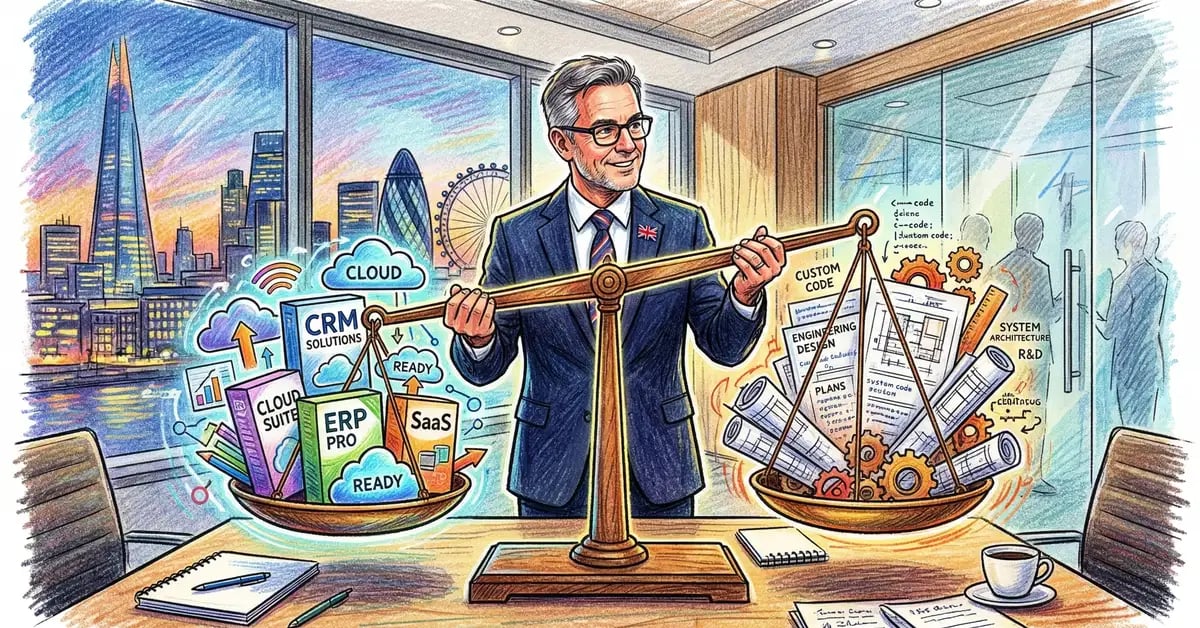
The build vs buy decision for AI is not a binary choice — it is a strategic sequencing question. Organisations that partner with specialist AI vendors reach deployment approximately 67% of the time, compared with about 33% for purely internal builds, according to MIT research published in 2025. The most effective approach for organisations with 150 to 1,500 employees is a staged hybrid model: buy first to validate the business case, extend with custom layers, then build where genuine competitive advantage demands it. This "buy to learn, build to last" progression validates value before committing to custom development, rather than staking everything on either path from the outset.
Key Takeaway
Do not treat build vs buy as an either/or decision. 57% of organisations surveyed by KPMG favour a blend of building and buying AI agents. The right question is not "should we build or buy?" but "what should we buy first, and what should we build later?" A staged approach proves value before committing budget to custom development.
67%
Buy Success Rate
Vendor-led implementations
33%
Build Success Rate
Internal development only
57%
Blended Approach
Organisations favouring build and buy
95%
Pilots Stalling
Little or no measurable P&L impact
Sources: MIT/Fortune 2025, KPMG 2026
Why the AI Build vs Buy Decision Is Different from Traditional Software
The build vs buy decision for AI differs fundamentally from traditional enterprise software procurement. With conventional software, requirements are well-understood, development timelines are predictable, and the technology stack is stable. AI introduces three complications that change the calculus entirely.
First, AI models degrade over time. Unlike traditional software that works until something breaks, AI systems experience data drift as the real-world patterns they were trained on change. Coherent Solutions lists performance monitoring, user feedback integration and adaptation among the usual post-deployment maintenance tasks. A custom-built sentiment analysis model trained on 2024 customer data may produce unreliable results by 2026 without ongoing investment in retraining infrastructure.
Second, AI talent commands a substantial premium. In England, machine learning engineers earn base pay of roughly $93,000 to $142,000 a year (mid-level to lead), with senior and lead data science engineers on roughly $85,000 to $106,000, according to 2026 salary research from Alcor (figures in US dollars). A custom AI project might require two to three ML engineers, one to two data engineers, and one to two data scientists — a substantial salary commitment for a six-to-twelve-month project, before infrastructure, training data, and overhead (see our full breakdown of AI development costs in the UK).
Third, 95% of enterprise AI pilots fail to deliver measurable returns (see our structured AI MVP development process). MIT's NANDA initiative documented that the vast majority of AI pilots stall and deliver little to no measurable impact on profit and loss statements. The core issue is not model quality but the "learning gap" — generic AI tools excel for individuals because of their flexibility, but they stall in enterprise contexts because they do not learn from or adapt to organisational workflows.
These three factors mean that the build vs buy decision for AI carries higher stakes, greater uncertainty, and more hidden costs than any equivalent technology procurement choice. Organisations that treat it like a standard software evaluation frequently underestimate the ongoing commitment required for either path.
The True Cost of Building Custom AI
Custom AI development costs vary significantly based on complexity, but most UK mid-market organisations underestimate the total investment required. Building a custom AI solution is not a one-time project — it is an ongoing operational commitment that compounds over multiple years.
| Complexity Tier | Examples | Development Cost | Annual Maintenance |
|---|---|---|---|
| Basic | Chatbots, recommendation engines, sentiment analysis, basic predictive analytics | $20,000–$80,000 | Ongoing; scope-dependent |
| Advanced | Customer segmentation, workflow automation, fraud detection, computer vision | $50,000–$150,000 | Ongoing; scope-dependent |
| Enterprise Custom | Trading platforms, predictive maintenance, medical diagnosis, bespoke NLP | $100,000–$500,000+ | Ongoing; scope-dependent |
Source: Coherent Solutions 2026 (development costs in US dollars)
The figures above represent development costs only. A realistic three-year total cost of ownership for an advanced custom AI project includes the initial build shown above, ongoing maintenance, infrastructure (Coherent Solutions puts cloud machine learning services at $1,000 to $100,000+ a month), model retraining cycles, and talent retention. Multi-year TCO for a single custom solution frequently far exceeds the initial build cost.
Infrastructure costs deserve particular scrutiny. GPU compute for model training and inference is expensive whether hosted on cloud or on-premises. However, Lenovo's 2026 TCO analysis demonstrates that on-premises deployment achieves breakeven in under four months for high-utilisation workloads. In its five-year comparison for one eight-GPU server running continuously, on-premises costs were approximately $1.5 million compared with $6.25 million for the equivalent AWS instance. For organisations committed to sustained, high-volume AI workloads, on-premises infrastructure offers dramatic cost advantages — but requires significant upfront capital expenditure that most mid-market businesses cannot justify for initial AI implementations.

The True Cost of Buying AI Solutions
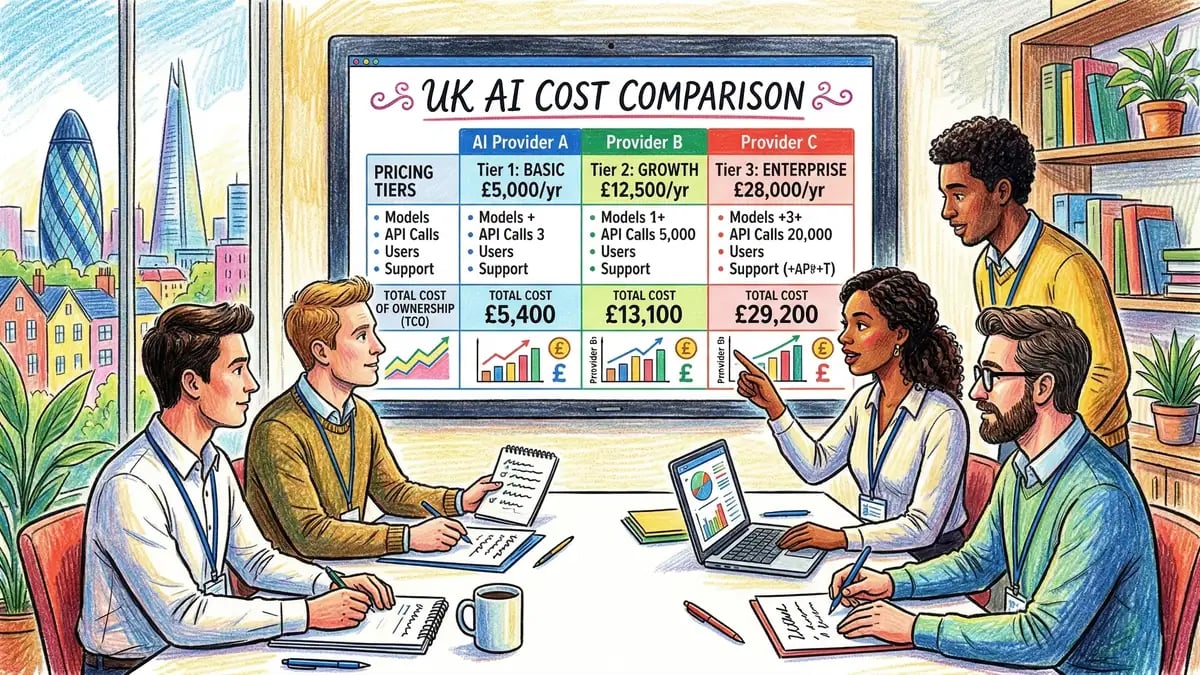
Purchasing AI solutions eliminates upfront development costs but introduces different financial dynamics that UK businesses must understand. The headline licensing or subscription fee is often only part of the actual implementation cost.
SaaS pricing has become increasingly volatile. Spend on AI-native applications averaged $1.2 million a year per organisation, up 108% year over year, according to Zylo's 2026 SaaS Management Index, and 78% of the IT leaders it surveyed reported unexpected charges tied to consumption-based or AI pricing in the past year. Many established vendors now layer an AI-premium tier on top of the base licence, sometimes bundled into renewals that customers cannot opt out of, whether or not the features are fully adopted.
Hidden Costs of Buying AI
Integration and customisation: Integration costs can equal or exceed software licensing fees, particularly where AI must connect to proprietary systems.
Vendor lock-in: Switching providers can require months of replatforming effort and substantial financial investment. Once dependent on a vendor's AI infrastructure, the cost of migrating data, retraining staff, and rebuilding integrations creates a material barrier to changing course.
Pricing escalation: SaaS renewal prices were up 14.3% year on year in early September 2026 data from Vertice, after peaking at 16.4% in June 2026, while general inflation has stabilised in many economies. Organisations committing to vendor AI solutions face compounding costs that erode initial ROI projections over three to five years.
Consumption-based pricing models create additional budgeting challenges. Microsoft Copilot costs $30 per user per month (requiring existing Microsoft 365 licensing). Salesforce Agentforce charges $2 per conversation. OpenAI charges per token, with pricing varying by model tier. These variable costs make it difficult to predict monthly AI expenditure as adoption scales across an organisation.
When Building Custom AI Is the Right Decision
Custom AI development is justified when specific conditions are met. Building makes strategic sense in the following scenarios.
Proprietary Data Creates Competitive Advantage
When your organisation possesses unique datasets — customer behaviour patterns, industry-specific compliance records, proprietary operational data — that no vendor solution can replicate. A logistics company with 15 years of route optimisation data has a genuine competitive moat that justifies custom model development.
Regulatory Requirements Demand Full Data Control
Financial services firms, healthcare organisations, and government contractors handling sensitive data may require complete data residency control that vendor solutions cannot guarantee. Custom development ensures data never leaves your infrastructure, with custom access policies and full audit trail ownership.
Vendor Solutions Meet Less Than 60% of Requirements
KPMG's 2026 decision framework recommends buying when vendor solutions meet more than 80% of needs. Below this threshold — particularly below 60% — the customisation effort to bridge the gap often exceeds the cost of building purpose-built systems from the outset.
AI Is Core to Your Business Strategy, Not a Support Function
When AI capabilities represent your primary product or service differentiation — not merely an efficiency tool — custom development ensures you control the roadmap. A fintech building AI-driven risk assessment as its core product needs to own that technology entirely.
Source: KPMG Agentic AI Untangled 2026
Even when these conditions are met, Helium42 advises most organisations to validate the business case with a purchased solution before committing to a full custom build. The 33% success rate for internal builds underscores why proving the use case first — even imperfectly — reduces risk substantially.
Need help deciding whether to build or buy? Helium42's AI Development Services include decision framework workshops that map the optimal path for your specific requirements.
Explore AI Development ServicesWhen Buying AI Solutions Is the Right Decision
Purchasing pre-built AI delivers faster time-to-value and lower implementation risk for the majority of use cases. Vendor solutions typically achieve deployment within 3 to 9 months compared with 12 to 24 months for custom development, according to HP's 2026 enterprise AI framework. For organisations in competitive industries where speed matters, this timeline difference is often decisive.
Buying is the right decision when the AI application addresses a commodity problem — one that many organisations face and where vendor solutions have been validated across hundreds of similar deployments. Customer service automation, CRM-integrated lead scoring, marketing content generation, and financial forecasting all fall into this category. When competitors have access to the same tools, the competitive advantage comes from implementation quality and organisational adoption, not from the underlying AI technology.
Buying is also appropriate when your organisation lacks internal AI expertise. Only 11% of UK businesses take a strategic, holistic approach to AI investment (up from 7% in 2025), according to SAP and Oxford Economics research covering mid-market and enterprise organisations. For the remaining 89% operating without a mature AI strategy, building custom solutions before understanding how AI integrates into business workflows is premature. Purchased solutions provide the practical experience needed to make informed build decisions later.
Finally, buying suits organisations that need to demonstrate AI value quickly to stakeholders. Board members and investors increasingly expect AI competence from leadership teams. A well-implemented purchased solution delivering measurable results within six months builds the organisational confidence and executive support needed for larger AI investments — including potential custom development — further down the line.
The Hybrid Approach: Buy to Learn, Build to Last
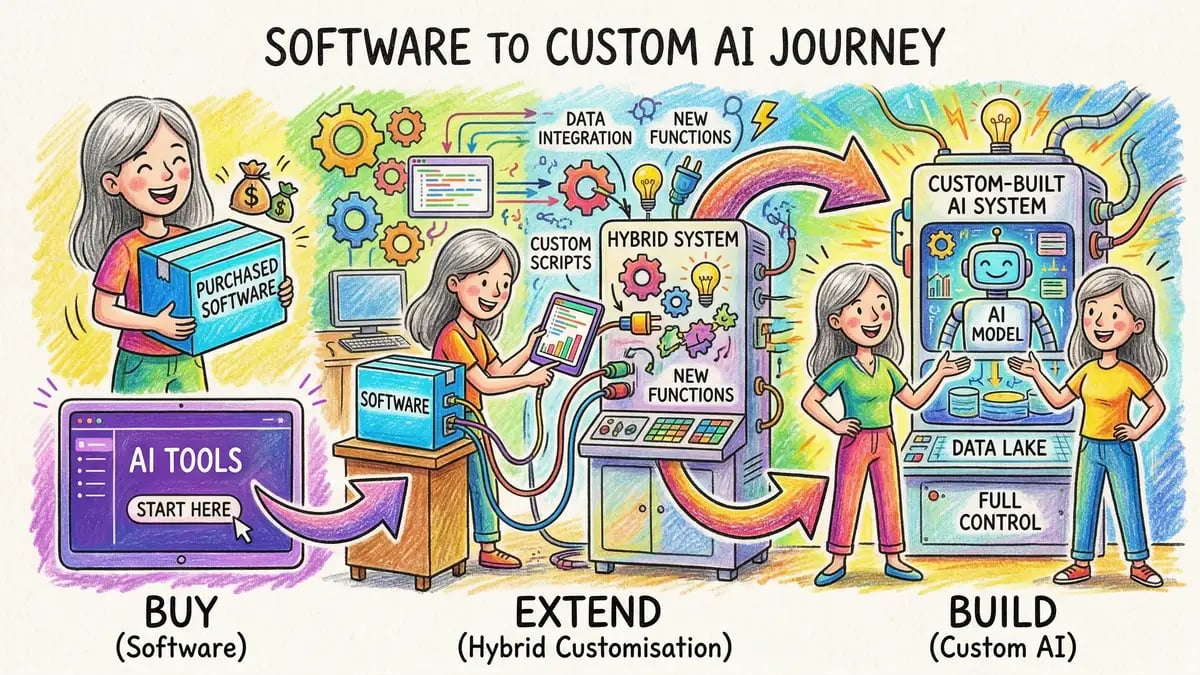
The most effective strategy for UK mid-market businesses combines purchased and custom AI capabilities in a staged progression. In KPMG's Q3 2025 AI Pulse Survey, 57% of organisations favoured a blend of building and buying AI agents, up from 51% in the previous quarter (KPMG, 2026). The three-phase maturity framework set out by Zartis structures this progression for practical implementation.
| Phase | Approach | Timeline | What Happens |
|---|---|---|---|
| Experiment | Buy off-the-shelf | 4–8 weeks | Purchase pre-built AI capabilities to validate business cases and build internal confidence. Aim for proof-of-value, not perfection. |
| Extend | Hybrid customisation | 3–6 months | Combine vendor APIs with orchestration layers and lightweight customisation. Connect AI to proprietary CRM, ERP, or data systems. Apply prompt engineering and fine-tuning for improved accuracy on company-specific use cases. |
| Evolve | Strategic custom build | 6–18 months | Develop custom-built systems addressing strategic priorities where proprietary data and unique business logic create genuine competitive advantage. Internal teams now have the AI literacy and operational experience to execute effectively. |
This progression works because each phase reduces risk for the next. The Experiment phase validates whether AI solves the business problem at all — answering the "should we invest" question before committing a substantial budget to custom development. The Extend phase reveals which specific capabilities require customisation beyond vendor defaults, providing precise requirements for any eventual custom build. The Evolve phase benefits from organisational AI maturity built through the first two phases, significantly increasing the likelihood of successful custom development.
A practical example illustrates the hybrid approach. A mid-market financial services firm might begin by purchasing an AI-powered customer support tool, achieving 30% reduction in call handling time within weeks (Experiment phase). The firm then connects the tool to its proprietary CRM, retrains responses on company-specific FAQs, and builds custom reporting dashboards (Extend phase). After 12 months of validated AI value and internal capability building, the firm develops a proprietary risk assessment model trained on its unique transaction data — creating genuine competitive differentiation that no purchased tool could replicate (Evolve phase).
Helium42's Build vs Buy Decision Framework
Helium42 has developed a practical scoring framework that maps organisations to the right approach. The framework evaluates five critical dimensions, each scored from 1 (strongly favours buying) to 5 (strongly favours building).
| Dimension | Buy Signal (Score 1–2) | Build Signal (Score 4–5) | Weight |
|---|---|---|---|
| Competitive Differentiation | AI supports operations (HR, finance, marketing tools) | AI is the core product or primary differentiator | 30% |
| Data Sensitivity | Standard business data, vendor compliance acceptable | Highly sensitive IP, regulated data, full residency required | 25% |
| Internal AI Capability | No ML engineers, limited data science experience | Established data team, ML engineering experience, infrastructure in place | 20% |
| Time-to-Value Pressure | Need results within 3–6 months, competitive urgency | 12–24 month horizon acceptable, strategic long-term play | 15% |
| Budget Availability | Under £100k for AI initiative, payback required within 12 months | Substantial budget available, willing to invest for 18–24 month payback | 10% |
Score interpretation: A weighted score of 1.0–2.5 points strongly toward buying. A score of 2.5–3.5 indicates the hybrid approach is optimal (buy first, then build selectively). A score of 3.5–5.0 supports building custom solutions, provided the organisation has validated the use case through a pilot first. Most UK mid-market organisations score between 1.5 and 3.0, confirming that buying or hybrid approaches are appropriate for the majority.
Risk Assessment: What Can Go Wrong with Each Approach
Understanding failure modes helps organisations mitigate risk regardless of which path they choose. Both approaches carry distinct risks that require proactive management.
Build Risks
Timeline overrun: Initial timeline estimates frequently expand due to underestimated data preparation, integration complexity, and evolving requirements.
Talent retention: Experienced UK ML engineers are frequently targeted by larger competitors. Losing a key engineer mid-project can set development back by months.
Technology obsolescence: Rapid AI model advancement means custom systems built on specific architectures may become outdated quickly, requiring continuous platform investment.
Buy Risks
Vendor lock-in: Once dependent on a vendor's infrastructure, switching can require months of replatforming and substantial investment. Data portability limitations compound the problem.
Pricing escalation: With SaaS renewal prices rising at double-digit annual rates through 2026, multi-year AI vendor commitments face compounding cost increases that erode projected ROI.
Differentiation erosion: When competitors access identical tools, AI becomes a cost of doing business rather than a competitive advantage. Organisations relying solely on purchased AI risk strategic commoditisation.
UK regulatory considerations add a further dimension. The UK Data and AI Ethics Framework, written for the public sector but a useful benchmark for any organisation, sets out principles of transparency, fairness, and accountability that apply equally to built and bought solutions. Under UK GDPR, a Data Protection Impact Assessment is required where processing is likely to result in a high risk, and the ICO states that in the vast majority of cases the use of AI will trigger that requirement, whether the system is custom or vendor-supplied. For organisations building custom solutions, this means embedding compliance into system design. For those buying, it requires rigorous vendor due diligence and contractual protections.
ROI Measurement: How to Know If You Made the Right Decision
Only 31% of UK businesses using AI report achieving positive ROI, according to Consultancy.uk research. Less than half can define what success looks like when implementing AI. This measurement gap affects both build and buy approaches — organisations that cannot define success metrics before implementation have no basis for evaluating outcomes afterwards.
Effective ROI measurement requires establishing baseline metrics before implementation across four dimensions: efficiency gains (labour time freed multiplied by fully loaded labour cost), revenue generation (incremental revenue from AI-enabled capabilities), risk mitigation (reduced probability of adverse outcomes multiplied by financial impact), and business agility (faster decision-making and market responsiveness). Helium42's implementation methodology includes pre-engagement baseline measurement across all four dimensions, ensuring organisations can quantify AI impact precisely.
When AI implementations do succeed, the financial returns are substantial. SAP research finds that UK businesses expect average returns on AI investment to rise from 22% in 2026 to 39% within two years. A Forrester Total Economic Impact study commissioned by Writer modelled 333% ROI over three years for a composite organisation using Writer's platform; vendor-commissioned figures of this kind are best treated as an upper bound.
Making the Decision: A Practical Checklist
For UK mid-market businesses preparing to make the build vs buy decision, the following checklist distils the framework into actionable steps. This checklist reflects the key decision criteria identified by KPMG and Helium42's own implementation experience.
Define the Business Problem First, Not the Technology
What specific business outcome do you need? What does success look like in measurable terms? If you cannot articulate the problem and success criteria clearly, you are not ready for either build or buy.
Audit Your Data Readiness
Is your data clean, accessible, and representative? Data quality is the most common bottleneck for both approaches. If data preparation will take months, start there before committing to any AI investment.
Run the Scoring Framework
Score your organisation on the five dimensions above (competitive differentiation, data sensitivity, internal capability, time pressure, budget). Let the weighted score guide your approach rather than assumptions or vendor pressure.
Start with a Pilot, Regardless of Direction
Whether you lean toward building or buying, validate the business case with a focused pilot first. Published UK market rates for a consultant-delivered pilot run from £5,000 to £35,000, according to the UK AI Consultancy Price Index — a fraction of the cost of committing to a full build or enterprise licence.
Plan for the Full Lifecycle, Not Just Launch
Calculate three-year TCO, not first-year costs. Include maintenance for custom builds, pricing escalation (double-digit annual SaaS price inflation through 2026), retraining cycles, and change management. The right decision at year one may be the wrong decision at year three.
Frequently Asked Questions
How much does it cost to build custom AI versus buying an off-the-shelf solution?
Custom AI development ranges from about £8,000 for basic solutions to £250,000 or more for enterprise-grade systems, depending on scope, with ongoing maintenance on top. Purchased AI solutions typically cost from about £8,000 to £250,000 or more in implementation, depending on scope, plus ongoing licensing. Three-year total cost of ownership for custom solutions frequently far exceeds the initial build cost when accounting for talent, infrastructure, and maintenance — though organisations with high-volume, sustained workloads can achieve significant cost advantages through custom on-premises deployment.
How long does it take to implement custom AI compared to buying a solution?
Purchased AI solutions typically deploy within 3–9 months, with focused implementations able to show initial results within weeks. Custom AI development typically requires 12–24 months to full production, according to HP's enterprise AI framework. A focused pilot using purchased or hybrid approaches allows organisations to validate the business case before committing to longer custom development timelines.
What is the success rate for building AI internally versus buying from vendors?
MIT research found that external partnerships with specialist vendors reached deployment approximately 67% of the time, compared with about 33% for purely internal builds. The primary failure factor for internal builds is the "learning gap" — enterprise AI requires organisational adaptation, not just technical capability. A hybrid "buy to learn, build to last" approach lets organisations prove value before committing entirely to custom development.
Can we start by buying AI and switch to building later?
Yes — this is the recommended approach for most UK mid-market businesses. The hybrid maturity model begins with purchased solutions to validate business cases (Experiment phase), progresses to vendor APIs combined with custom layers (Extend phase), then transitions to strategic custom development where competitive advantage demands it (Evolve phase). This staged progression reduces risk, builds organisational AI literacy, and ensures custom development investment targets genuinely differentiating capabilities.
What are the main risks of vendor lock-in with purchased AI?
Vendor lock-in creates three primary risks: pricing escalation (SaaS renewal prices were up 14.3% year on year in early September 2026, according to Vertice), switching costs (often months of replatforming effort), and data portability limitations. Organisations can mitigate these risks through contractual protections (price caps, data portability clauses, termination assistance), multi-vendor strategies that avoid dependence on a single provider, and ensuring data remains accessible in standard formats regardless of the vendor relationship.
How do UK data protection regulations affect the build vs buy decision?
UK GDPR requires a Data Protection Impact Assessment where processing is likely to result in a high risk, and the ICO states that in the vast majority of cases the use of AI will trigger that requirement, whether the system is custom-built or purchased. Custom solutions provide complete data residency control and audit trail ownership. Purchased solutions require vendor due diligence on data processing practices, infrastructure location, and international data transfer mechanisms. The UK's pro-innovation regulatory approach applies existing laws through sector regulators rather than creating blanket AI-specific regulation, making compliance achievable through either approach with appropriate governance frameworks.
Ready to Make the Right Build vs Buy Decision?
Helium42 helps UK mid-market businesses navigate the build vs buy decision with structured frameworks, pilot programmes, and end-to-end implementation support.
Peter Vogel
AI Transformation Strategist, Helium42
Peter is AI Strategy Lead at Helium42, helping UK and European businesses navigate the build vs buy decision through structured frameworks and pilot programmes. Drawing on a track record of digital marketing transformation programmes for over 500 organisations, he specialises in translating AI capability into measurable business outcomes.
generative AI development services
machine learning development services
running an AI proof of concept
evaluating AI development partners
enterprise AI application development
selecting an AI software development agency